What is a qubit?
Published on Apr 26, 2026 in Quantum Computing
Everyone is talking about quantum computing. But few people really know what it is. However, it is not such a complicated subject to discover. That’s why I decided to start a new series of articles on this topic.
As usual in my articles, I’ll try not to overdo it with math to keep it accessible. That said, if you don’t have any basics in linear algebra and you’re not a little comfortable with trigonometry and rotation matrices, you’re going to struggle.
I won’t go into detail about the underlying physical principles. Everyone has a vague idea of what superposition and entanglement is. That will be enough for you to follow these articles.
The interest of quantum computing is to be able to perform calculations with zeros and ones at the same time on each qubit. With n qubit, a single calculation replaces 2^n calculations.
Unfortunately, as you’ll see, a quantum computer doesn’t work at all like a classical computer, and it’s not possible to apply any algorithm in quantum mode. A quantum computer can run only quantum algorithms.
To begin, let’s find out what a qubit is.
TLDR, when a bit represents the two poles of a sphere, a qubit represents the entire surface of the sphere.
But let’s get into a little more detail. A classic bit can be set to 0 or 1.
A qubit is a two-level quantum system whose state can be a linear combination (superposition) of two base states denoted |0⟩ and |1⟩.
The notation I just used is the ket notation, introduced by Paul Dirac to represent quantum states.
The base states of a qubit are |0⟩ and |1⟩ (read “ket zero” and “ket one”). The general state of a qubit is written: |ψ⟩ (read “ket psi”) = α|0⟩ + β|1⟩ where α and β are complex numbers called amplitudes.
The probability of getting 0 by measuring |ψ⟩ is the square of the modulus of α (noted |α|²) and the probability of getting 1 is the square of the modulus of β (noted |β|²). So, we have |α|² + |β|² = 1 (the total probability).
For those who have forgotten, the modulus of a complex number is the square root of the sum of the squares of the real part and the imaginary part. If we have α=a+ib, |α|=√(a²+b²).
I would also like to remind you of the concept of superposition. |ψ⟩ contains α and β simultaneously, it is not a simple statistical mix.
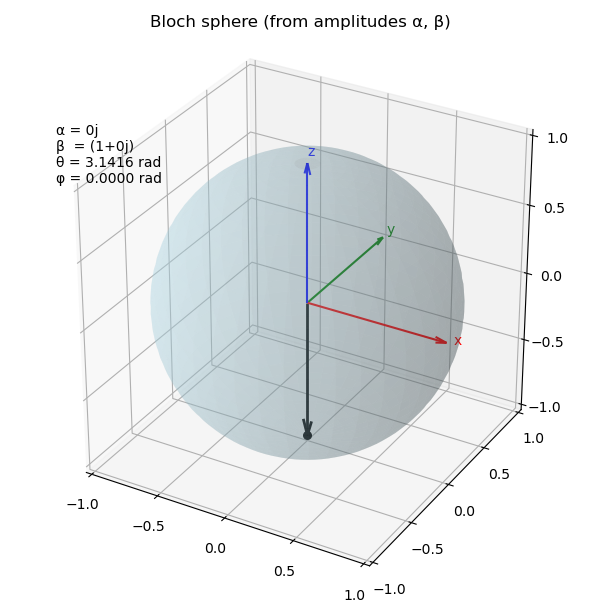
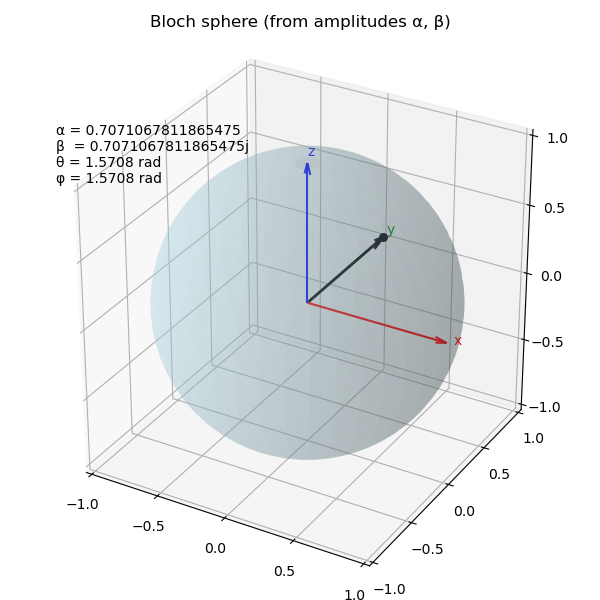
A qubit can be represented as a point on the Bloch sphere. Two real parameters, θ the colatitude, and φ the longitude, can describe α and β via: α = cos(θ/2), β = e^(iφ) sin(θ/2).
Note: the Euler’s formula, e^(iφ) = cosφ + i sinφ
Some examples:
The |0⟩ (α=1, β=0) and |1⟩ (α=0, β=1) states correspond to the poles.
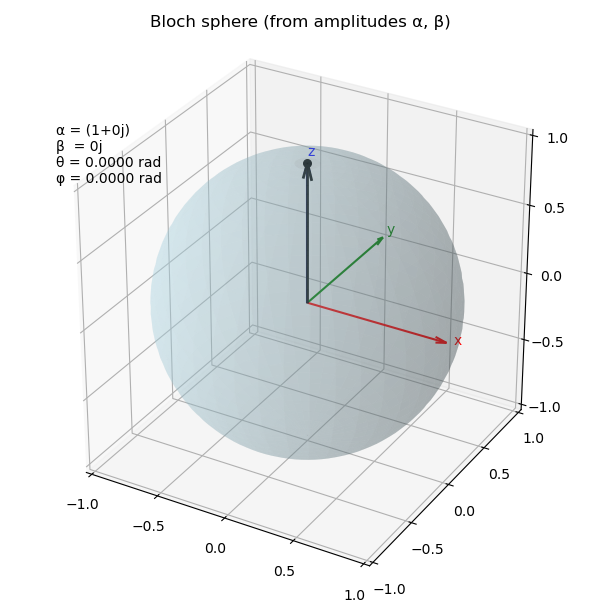
Note: In python, the i of complex numbers is replaced by a j. Since I created these representations with python/matplotlib, I kept this notation to avoid having to do a display conversion.
The equator corresponds to the equal state, 50%-50% (α = 1/√2, β = (cosφ + i sinφ)/√2) , with φ ∈ [0,2π) (here, φ = π/2).
Don’t miss my upcoming posts — hit the follow button on my LinkedIn profile